Official civic exam theme
History, geography and culture of France
From the French Revolution to the building of Europe, this theme requires landmarks more than erudition: key dates, major figures, essential geography and cultural heritage. Here is the backbone to know for the exam.
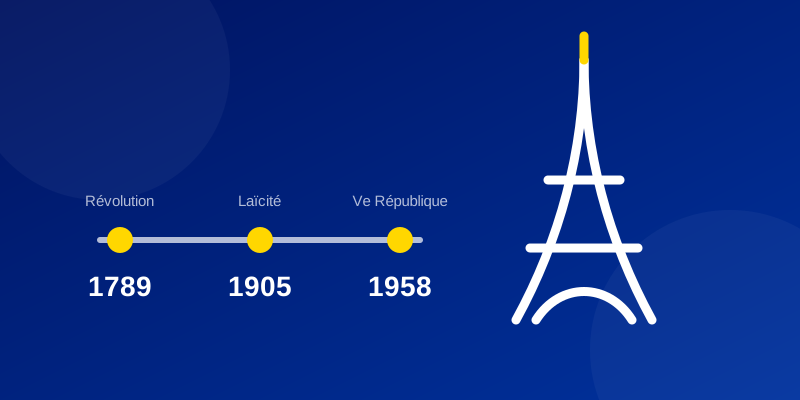
Key dates in French history
A few milestones recur constantly: 1789, the French Revolution and the Declaration of the Rights of Man; 1792, the First Republic; 1848, the definitive abolition of slavery (décret Schœlcher) and universal male suffrage; 1905, the separation of Church and State; 1944, women's right to vote; 1958, the Fifth Republic; 1981, the abolition of the death penalty (loi Badinter).
For the two World Wars: 1914–1918 and 1939–1945, including General de Gaulle's appeal of 18 June 1940 and the Liberation of 1944–1945. 8 May and 11 November are public holidays commemorating the ends of these conflicts — a classic link between dates and everyday life.
Key historical figures
Expected figures include: Vercingétorix and Clovis for the origins, Joan of Arc (Jeanne d'Arc), Louis XIV and the Palace of Versailles, Napoleon Bonaparte and the Civil Code (Code civil) of 1804, Victor Hugo and Voltaire for literature, Marie Curie (two Nobel prizes), Louis Pasteur, Charles de Gaulle and Simone Veil — whose 1975 law on abortion and entry to the Panthéon in 2018 are regularly cited.
The exam does not ask for biographies but for the ability to link a figure to their work or era. Flashcards and repeated practice are the most effective method for making these associations stick.
The geography of France
Metropolitan France is bordered by the English Channel (Manche), the Atlantic Ocean and the Mediterranean Sea, and shares land borders with Belgium, Luxembourg, Germany, Switzerland, Italy, Monaco, Spain and Andorra. Major rivers: the Loire (the longest), the Seine, the Rhône, the Garonne and the Rhine. Mountain ranges: the Alps (Mont Blanc, highest peak in Western Europe), the Pyrenees, the Massif central, the Jura and the Vosges.
Do not forget the overseas territories: Guadeloupe, Martinique, French Guiana, Réunion and Mayotte are French overseas departments and regions; France thus has a presence in several oceans. Paris is the capital; Marseille, Lyon and Toulouse are among the largest cities.
Culture and heritage
France's cultural heritage on the syllabus ranges from monuments (the Eiffel Tower, built for the 1889 World's Fair; the Louvre; Notre-Dame; Versailles; Mont Saint-Michel) to cultural institutions (the Académie française, festivals and traditions). French gastronomy is listed as UNESCO Intangible Cultural Heritage.
Contemporary landmarks: la francophonie brings together countries that share the French language; 14 July is the national holiday, recalling the storming of the Bastille (1789) and the Fête de la Fédération (1790). These « general culture » questions are among the most accessible in the exam.
Test yourself on this theme
Reading alone is not enough: practising MCQs is what makes knowledge stick. Start with the free 10-question quiz on this theme — no account needed, with an explanation for every answer — then move on to full training.
Other exam themes
Frequently asked questions
Do I need to know specific dates?›
Yes, around twenty key dates are enough: 1789, 1792, 1848, 1905, 1914–1918, 1939–1945, 1944, 1958, 1981… The exam tests landmarks, not an exhaustive timeline. Repeated practice through flashcards or MCQs fixes them lastingly.
Does this theme also cover geography?›
Yes: borders, rivers, mountain ranges, major cities and overseas territories are part of the official syllabus, alongside history and cultural heritage.
How much detail is needed for historical figures?›
You need to link each major figure to their work or era: Napoleon to the Civil Code, Marie Curie to her Nobel prizes, Simone Veil to the 1975 law. Questions remain factual and do not require historical analysis.